
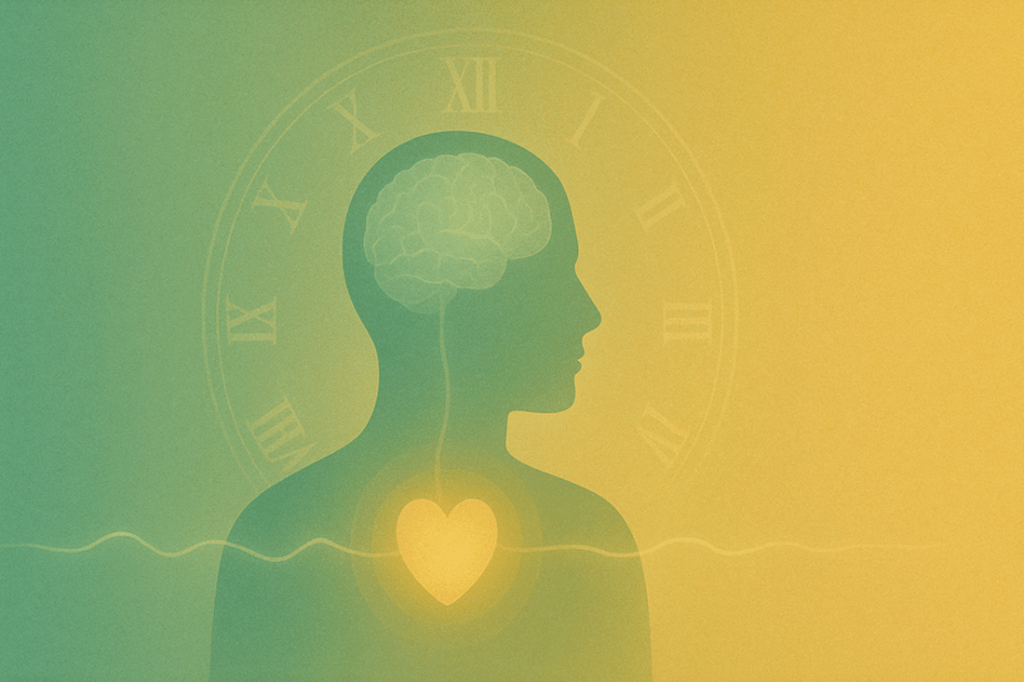
The passage of time is fundamental to our experience. As I am writing this, a notification pops up for a meeting starting in thirty minutes. Surely, I can finish this paragraph. But after typing, deleting and rearranging words in a desperate attempt to describe this project in the cleverest way possible, I glance at the digits at the bottom right-hand corner of my screen. To my horror, it has been thirty-two minutes since I typed the first word. Thirty-two minutes in what felt like barely ten! Cursing, I hastily gather my notes for the meeting to which I am now late.
Such speeding of time during extreme focus with a mentally taxing task is a typical experience, yet the acute time distortion still catches me off guard. It illustrates that our perception of time is malleable. If I impatiently waited for a reply to a text message, the same thirty-two minutes could have stretched to feel like an hour.
As a cognitive neuroscientist, I want to know how the brain creates such a malleable sense of time. There is no sense organ for time like there are eyes and specialised brain areas that construct visual experiences. Instead, it is proposed that the brain infers duration and creates a sense of temporal passage by detecting change across neural activity. Modulating the speed of neural activity should modulate how fast time seems to pass. But the brain is an inseparable part of the body. All neural activity ensues against the backdrop of unceasing physiological processes occurring inside the body, like the beating of the heart.
Each time the heart contracts, the heart-brain communication pathway activates, informing the brain about the state of the body, whereas when the heart relaxes, the pathway shuts. Notably, the brain modulates its neural activity in response to these fluctuating cardiac phases – being more likely to act during contraction and process new information during relaxation. I discovered that our experienced duration also contracts and expands along these cardiac fluctuations, establishing an experimental paradigm to examine time perception arising from an intricate brain–heart interplay. By combining this paradigm with EEG and fMRI methods, this project will clarify the underlying neural mechanisms that give rise to time distortions. Once we understand how the brain constructs experienced time, we may learn how to modulate it, perhaps by changing the body’s internal state or by better attuning to our bodily signals.


 Irena Arslanova
Leave a comment